January 11, 2026
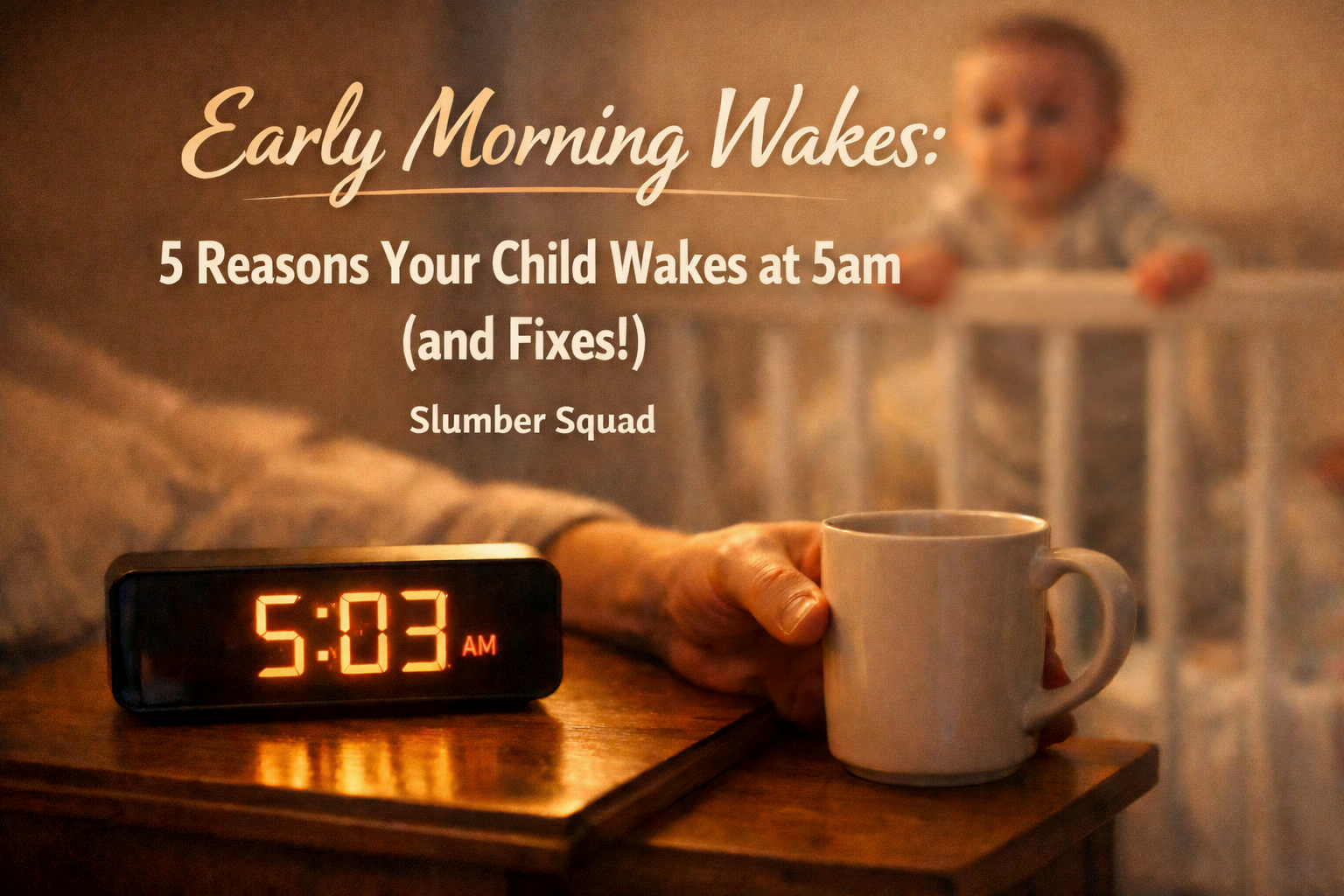
Early Morning Wakes: 5 Reasons Your Child Wakes at 5am (and Fixes!)
Short answer: a consistent wake before 6:00am is almost always caused by one of five things — overtiredness at bedtime, too much daytime sleep, light in the room at dawn, genuine hunger, or needing your help to fall asleep. Fix the cause and the mornings move; push bedtime later and they usually get worse.
Is there anything more soul-crushing than seeing the clock strike 5:15 AM and hearing your little one ready to start the day?
Welcome to the "Early Rising Club"—the club no parent wants to be a member of.
At Slumber Squad, we define an Early Morning Wake (EMW) as any consistent wake-up before 6:00 AM. These wakes are notoriously the hardest sleep issues to crack. Why? Because between 4:00 AM and 6:00 AM, your child's sleep pressure is at its lowest, their melatonin is dropping, and their body is gearing up to wake up anyway.
If you are stuck in a cycle of 5 AM starts, it's rarely just "bad luck." There is almost always a root cause. Here are the five most common reasons your child wakes early, and exactly how to fix them.
Reason 1: Overtiredness at Bedtime
This is counterintuitive, but it is the #1 cause of early rising. Many parents think, "If I keep them up later, they'll sleep in later!"
Unfortunately, baby sleep doesn't work like adult sleep. When a child stays awake past their optimal window, their body releases cortisol and adrenaline (stress hormones) to keep them going. This "second wind" makes it harder to fall asleep and, crucially, causes them to jolt awake in the early hours of the morning when sleep is lightest.
The Fix: An Earlier Bedtime
Don't fear the 6:30 PM bedtime! If your child's naps were short or they had a highly stimulating day, bring bedtime forward by 30–45 minutes. An earlier bedtime helps them catch up on sleep debt, preventing that 5 AM cortisol spike.
Reason 2: Undertiredness (Not Enough Sleep Pressure)
The opposite side of the coin is a child who simply isn't tired enough to sleep a full 11–12 hours overnight. This often happens when daytime naps are too long, or the final awake window before bed is too short.
If your toddler still naps for 3 hours during the day, they may only need 9 hours at night, meaning a 7 PM bedtime results in a 4 AM wake-up.
The Fix: Tweak the Schedule
- Cap Naps: You may need to shorten daytime sleep to ensure they are tired enough for night sleep.
- Stretch the Last Window: Ensure there is enough "awake time" before bed to build sufficient sleep pressure. For a toddler, this might mean 4+ hours before bedtime.
Reason 3: The Environment is Too Bright
We cannot overstate this: even the tiniest crack of light signals to a baby's brain that it's "morning time."
Around 5 AM, sleep is very light. If the sun is starting to rise, or a streetlight is shining through the curtains, your child's brain will stop producing melatonin and start producing serotonin—the "wake up" hormone.
The Fix: Pitch Black Darkness
Make the room cave-like. Use blackout blinds, and tape garbage bags over the windows if you have to—get that room as dark at 5 AM as it is at midnight. If you can see your hand in front of your face, it's not dark enough.
Still not sure what's going on with your little one's sleep?
Every child is different — and sometimes you need more than an article. Send Sam a short message and you'll get a personal reply within one business day, or explore our gentle sleep consulting packages.
Reason 4: Genuine Hunger
For babies under 9 months, or toddlers going through a significant growth spurt, a 5 AM wake might genuinely be hunger. Their stomachs are empty after 10 hours of sleep.
The Fix: Assess Calories and The "Snooze Button"
Feed First: Ensure they are getting enough full feeds or solid meals during the day. Try not to let daytime feeds become snacky.
If you suspect hunger, treat the 5 AM wake strictly as a night feed. Keep the lights off, keep interactions silent, feed them, burp them, and place them straight back into the crib. Do not start the day. This is often called a "snooze button feed" to buy you another hour or two of sleep.
Reason 5: Sleep Associations
How does your child fall asleep at the start of the night? Do you rock them, feed them to sleep, or lay with them until they drift off?
If they rely on your help to fall asleep at 7 PM, they will need that exact same help when they naturally stir at 5 AM. The difference is, at 5 AM, the drive to sleep is very low, so rocking them back to sleep is much harder than it was at bedtime.
The Fix: Independent Sleep Skills
The key to fixing early mornings often lies at bedtime. Teaching your child to fall asleep independently in their crib means that when they wake at 5 AM, they have the skills to connect that sleep cycle and drift back off for another hour without needing you to intervene.
When early waking is developmental (and when it is fixable)
Some early waking is a passing phase: the 4-month change in sleep cycles, a nap transition, teething, illness, or a new skill like standing or walking. These usually settle within two to three weeks if you hold the schedule steady. What is fixable is anything structural — a bedtime that is consistently too late, a nap that is too long, light leaking in at 5am, or a child who cannot yet fall asleep without you. If the pattern has lasted more than a month with a consistent schedule, it is not developmental; something in the setup needs to change.
A real example
One family we worked with had a 14-month-old waking at 4:50am for three months. Bedtime was 8:00pm because "she wasn't tired," and she was napping 2 hours 45 minutes each afternoon. We capped the nap at 2 hours, moved bedtime to 7:00pm, and added blackout coverage to the top corner of the window where the blind did not quite meet the frame. Nights 2 and 3 were worse. By night 9 she was waking at 6:20am, and by week three, 6:45am. Nothing dramatic — three small changes, held steady.
Hanging up Your Membership Card
Fixing early morning wakes takes consistency and patience. It often gets worse before it gets better as their body clock readjusts.
If you've tried these fixes and are still greeting the sun every morning, the Slumber Squad is here to help look at your unique situation and build a personalized plan. Hang in there, squad!
Ready to finally sleep past 6 AM? If early rising is your one big problem, a focused Sleep SOS Session gets you a written plan fast — or send us a message about your child and we'll help you choose the right level of support.
Tell us about your child's sleep
If any of this sounds familiar, you don't have to keep guessing. At Slumber Squad Sleep Consulting we build personalised sleep plans around your actual child — no one-size-fits-all advice, no cry-it-out. Write to us below (or email sam@slumbersquadsleep.com), or explore our gentle sleep consulting packages.