July 20, 2026
How to Build a Neurodivergent-Friendly Bedtime Routine
By Sam Rosenberg
For a lot of neurodivergent kids, bedtime is not resistance — it is a transition their nervous system genuinely struggles to make. The lights change, the noise level changes, the pace changes, and the day of holding it together at school suddenly catches up all at once. A calm, sensory-aware routine is not a luxury for these kids. It is the intervention.
Here is the framework I use with autistic, ADHD, and sensory-sensitive families, in the same order I coach it.
1. Reduce verbal overload
Talking more feels helpful. It usually is not. By 7 pm, most neurodivergent kids have already processed thousands of words and hundreds of transitions. Shrink your language: short sentences, key words only, and generous pauses so their brain can catch up. Save the connection chat for the cuddle at the end, not the toothbrushing.
2. Use a visual schedule
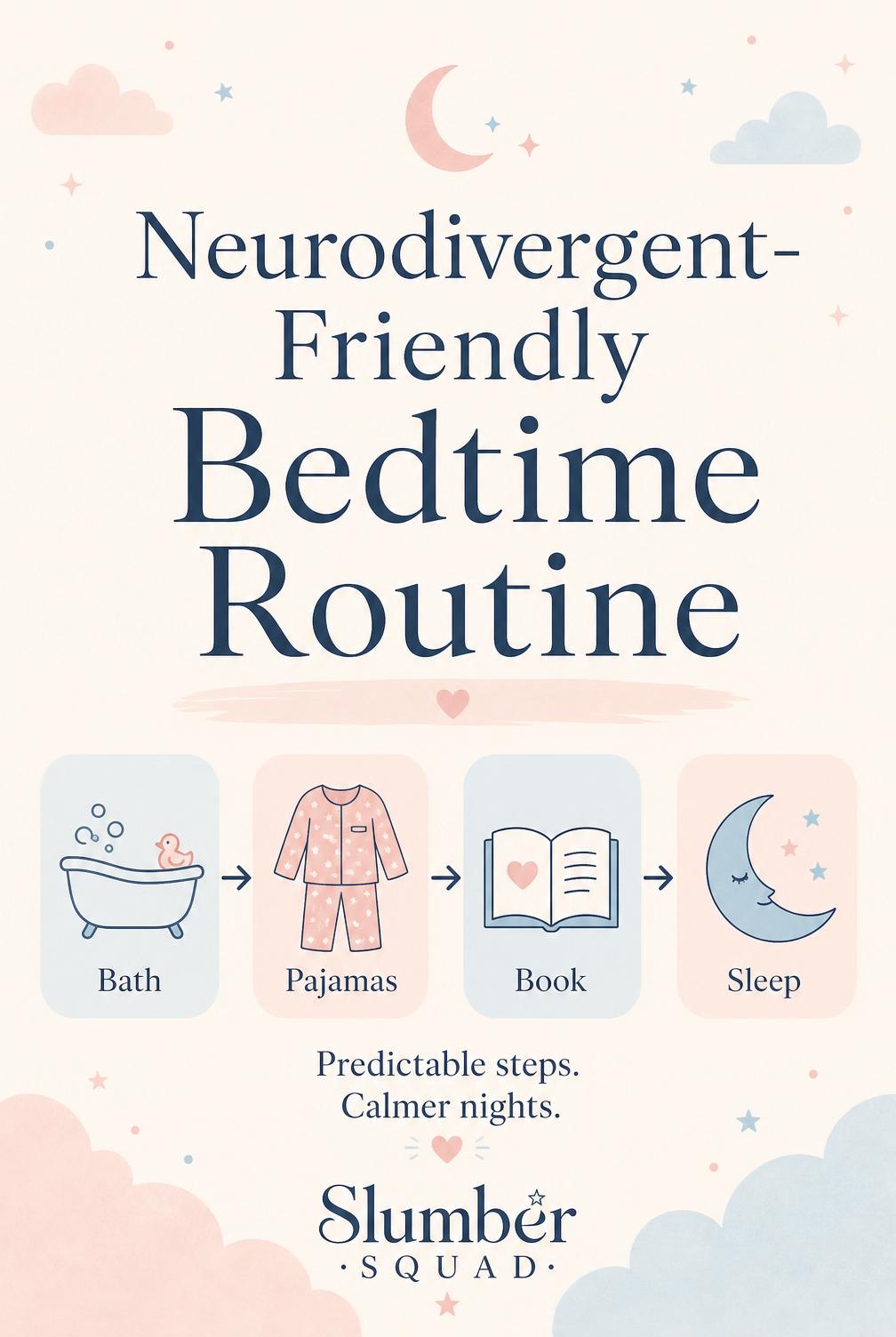
A visual bedtime schedule is the single most under-used tool in pediatric sleep. Pictures externalize the routine so it doesn't live inside your voice. Your child can see what's happening now and what's coming next, which is exactly what a regulated brain needs.
You can draw one on paper, laminate stock photos, or use a done-for-you printable like our Neurodivergent-Friendly Bedtime Visual Routine, which was designed with autistic and ADHD kids in mind.
3. Build in sensory accommodations
The routine has to fit this child, not a generic child. A few of the most common wins I see:
Still not sure what's going on with your little one's sleep?
Every child is different — and sometimes you need more than an article. Send Sam a short message and you'll get a personal reply within one business day, or explore our gentle sleep consulting packages.
- Warm bath (or skip it entirely if it dysregulates)
- Seamless, tag-free pajamas in a preferred fabric
- Deep-pressure input that fits your child — firm hugs, a snug tuck-in, or a supervised squeeze before lights out. Weighted blankets are a separate question with real safety limits: see weighted blankets and child sleep safety.
- Dim, warm-toned light rather than overhead brightness
- White or brown noise to buffer household sounds
- A predictable transition object (specific stuffed animal, blanket, book)
4. Offer bounded choices
Choice supports autonomy; unlimited choice overwhelms. Offer two, not ten: "Blue pajamas or dinosaur pajamas?" "Book on the bed or book on the floor?" This preserves felt-safety and control without turning bedtime into a menu.
5. Hold warm limits
Warm does not mean wobbly. Neurodivergent kids often feel safer with a clear, kind edge than with a rule that moves. "I hear you. It's still bed time. I'm right here." Empathy for the feeling, follow-through on the limit. Both, at once.
6. Know when to get individualized support
If you've held a consistent routine for two to three weeks and bedtime is still taking 90+ minutes, if your child regularly wakes distressed and cannot re-regulate, or if daytime is being eaten alive by sleep deprivation, a personalized neurodivergent sleep plan is worth it. The framework above works. The details — timing, sensory profile, medication interactions, co-occurring anxiety — need a human, not a listicle.
Your printable starter
If you want the visual schedule already made — icons, order, and cards designed for neurodivergent kids — the Neurodivergent-Friendly Bedtime Visual Routine is on our Etsy shop and ready to print tonight.
Educational content, not medical advice. Every child is different — if sleep challenges persist or you have concerns about your child's development or health, please consult your pediatrician or a qualified provider.
Sharing bedtime with another caregiver? Try this gentle bedtime handoff.
Tell us about your child's sleep
If any of this sounds familiar, you don't have to keep guessing. At Slumber Squad Sleep Consulting we build personalised sleep plans around your actual child — no one-size-fits-all advice, no cry-it-out. Write to us below (or email sam@slumbersquadsleep.com), or explore our gentle sleep consulting packages.